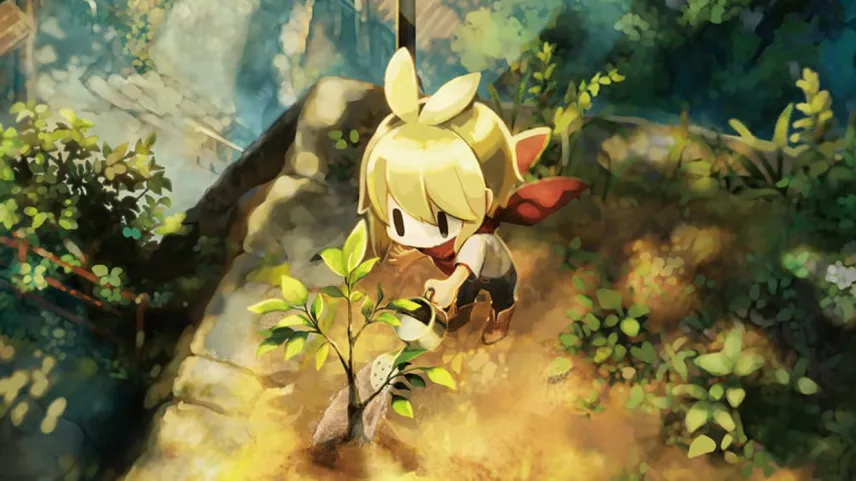
Life simulation games that allow players to retreat to a rustic countryside—enjoying a relaxed, self-sufficient existence on a farm—are far from rare. In fact, the genre is packed with excellent titles, meaning any new entry following this formula must offer something truly compelling to stand out. At first glance, Village in the Shade—the latest release from NIS America for Switch, “Switch 2,” PlayStation 5, and PC—appears to be just another lighthearted farming game. But as the old saying goes, appearances can be deceiving—and in this case, the deception runs quite deep.
As early as the tutorial, you begin to sense that something is amiss. While chasing after an escaped chicken, you stumble upon something deeply unsettling. The events that follow only deepen the mystery, accompanied by a series of chilling, eerie visuals. Yet, after all that, your character miraculously reappears, staggering into the village of Kagajin in desperate need of help.
At first, the villagers of Kagatsu seem welcoming, but you soon realize that those in charge are not entirely selfless. They don’t view you as a victim in need—but rather as a tool for extracting profit. You are cast onto a patch of squalid farmland—graciously “rented” to you—and forced to sleep in a dilapidated shack that looks like it was plucked straight out of a match-three mobile game ad. They tell you that if you wish to remain among them, you must become one of them—and that requires labor. Until then, no one will speak to you.
Once you finally harvest your first meager crop of turnips and offer them to the spirits, you officially become a resident of Kagatsu. But with this comes a set of rules—rules that must be followed. They are strange, arbitrary, and intensely controlling—bordering on the practices of a cult. “Do not reveal the secrets of others.” “Do not search for lost items.” “Do not approach strangers.” And one rule, in particular, is emphasized repeatedly: “Do not go outside after 11:00 PM.”
But now, they’re finally willing to talk to you—the people here seem quite friendly. Rokkaku is a single father who runs the local restaurant and dotes on his adopted niece, Yo. Hasumi might lack a medical license, but she clearly cares deeply about everyone’s well-being. Kaori Sayama runs the general store, fully committed to providing you with the tools you need to succeed. Kisuke may be gruff and short-tempered, but beneath that construction worker’s exterior lies a truly kind heart. They’ll teach you how to fish, build animal enclosures, hunt, and craft all sorts of tools. They all seem like good-natured folks, even if they were a bit standoffish at first. (Well, everyone except that smooth-talking Konno—the guy practically radiates “manipulative crypto-bro” energy.)
Still, you can’t help but feel that everyone is hiding a secret. You catch glimpses of odd behavior now and then, or overhear snatches of conversation you weren’t meant to hear. There are strange noises in the night, too—like someone knocking on your door in the dead of night, letting out muffled screams. Oh, wait—never mind, it’s just Yu. She’s feeling lonely and wants to sleep with the chicks she adopted—the ones currently living in your chicken coop. That’s probably fine, right?
In the end, circumstances force you to break the most sacred rule of all: you step out of your home at the stroke of midnight. There, you encounter terrifying, otherworldly monsters—creatures that pursue you, obscure your vision, and send the haptic feedback in your game controller into a frenzy. You witness things—many things, in fact—that no human was ever meant to see. You had your suspicions, and you even anticipated this, but that doesn’t make it any less chilling.
You begin to question the motives behind everything. Entering your own produce into the town’s public agricultural competition seems harmless enough—yet, just a few days ago, you were told you must either pay a tithe or undergo a mysterious “blood-collection medical exam.” Given the dangers lurking out there, you can’t help but wonder if hunting down a few animals might actually be an act of mercy. And then there are those areas that have been deliberately cordoned off. Sure, you’ll gradually unlock them as you explore, but just how much progress do you actually need to make?
This is the true face of Kagatsu: a place that appears warm and cozy, yet harbors a sinister undercurrent. The game features a striking, painterly 2D art style that is immediately captivating. Its life-simulation mechanics are accessible and intuitive, offering a genuine sense of accomplishment as you build a farm from the ground up. Yet, even in the most idyllic moments—whether it’s a bountiful harvest, the completion of a new piece of equipment for crafting unique food items, running errands for the townsfolk, or bestowing thoughtful gifts—a dark, unsettling shadow always seems to stir in the periphery.
Ever since I started playing Village in the Shadows, I’ve been completely hooked. It masterfully weaves themes of deception and unease into the fabric of everyday life, plunging you into a peculiar emotional state that is simultaneously comforting and tense. The sharp contrast between the familiar, heartwarming rhythms of a life-sim and the chilling, horrific reality lurking beneath is utterly fascinating. I found myself both eagerly anticipating and dreading every new development in my life within the village. If you’re looking for a life-sim unlike any other—or perhaps a horror game that breaks the mold—then pick up your tools and join the village.