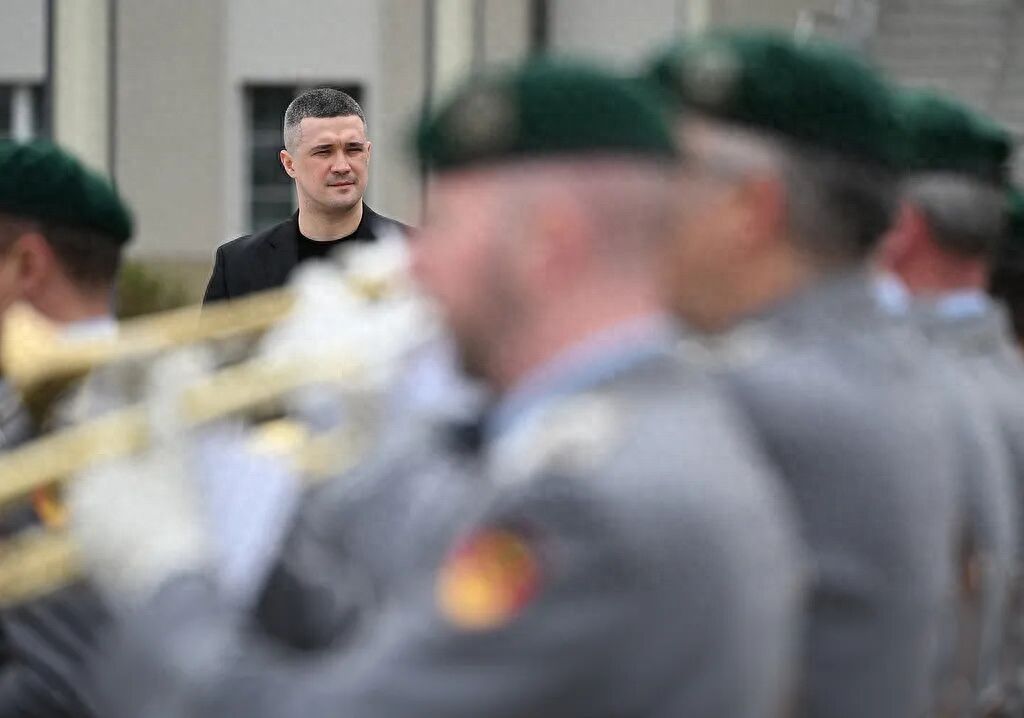
The Fall of the Prodigy: Mykhailo Fedorov’s High-Stakes Defiance and Ukraine’s Looming Political Crisis
After a brief silence, Mykhailo Fedorov, who was dismissed as Ukraine’s Defense Minister over a month ago, suddenly spoke out publicly on social media on August 18, calling for Ukraine to hold a presidential election during wartime.
“We need to answer a fundamental question: how should the state operate if the war continues for several years?” Fedorov emphasized in a video speech lasting more than nine minutes, arguing that Ukraine’s presidential election should not be “determined by Russia.” He also hinted that his dismissal had left Ukraine “without a qualified defense minister,” stating that “this situation is particularly dangerous when society begins to realize that the primary criterion for appointing someone is not their competence and achievements, but their personal loyalty.”
In response to Fedorov’s views, an official from the Office of the President of Ukraine told media outlets on August 19: “Planning an election while surrounded by missiles and drones is utterly unimaginable.”
“Backstabbing” the President
Fedorov’s video accumulated 230,000 views and 28,000 likes within 24 hours. His arguments were directed squarely at President Volodymyr Zelenskyy. Previously, Zelenskyy had consistently delayed the presidential election on the grounds that Ukraine was “in a state of war,” maintaining that the vote must wait until hostilities ended. Consequently, Russia has labeled the Zelenskyy government “illegitimate” and incorporated “holding elections in Ukraine” into its peace-talk framework. Since 2025, U.S. President Donald Trump has also repeatedly expressed similar views.
Fedorov’s speech marked the first time a core figure in Ukrainian politics publicly endorsed the positions of the U.S. and Russia. At 35, Fedorov was a long-time leader of the Zelenskyy administration’s digital transformation efforts. After February 2022, he single-handedly built Ukraine’s “cottage-industry” drone production network, championing unmanned aerial vehicles as the key weapon for asymmetric combat against the Russian military.
In January 2026, Fedorov assumed the post of Defense Minister. However, after pushing for disruptive reforms within the military and military-industrial system, he clashed fiercely with then-Commander-in-Chief of the Armed Forces Oleksandr Syrskyi, leading to his dismissal after serving for only half a year.
In recent years, top military and political figures like former Commander-in-Chief Valerii Zaluzhnyi and former Foreign Minister Dmytro Kuleba were dismissed or sidelined by Zelenskyy due to ideological differences or “overshadowing the leader.” In late late 2025, Ukraine’s “number two figure,” Head of the Presidential Office Andriy Yermak, was sacrificed in a corruption scandal. Upon leaving the centers of power, these figures either remained silent or offered constructive criticism of the government, but they never questioned Zelenskyy’s authority as a wartime leader.
Fedorov chose an entirely different path: going toe-to-toe with the president through a series of public statements that echoed grassroots protest movements. First, he forced Zelenskyy to dismiss Syrskyi, and now he has steered the debate toward the most sensitive topic of all—elections. Some commentators have remarked that this is the most severe “backstab” Zelenskyy has faced since February 2022. Why would the “post-90s” Fedorov act this way? Is it merely youthful bravado?
On a personal level, after days of silence, the most direct reason behind Fedorov’s escalation of pressure on Zelenskyy remains his position. According to Ukrainian media reports, officials from the Presidential Office recently held private contacts with Fedorov, offering several posts, including a newly created position as “Deputy Prime Minister for Military Innovation.” However, Fedorov insisted on remaining as Defense Minister and refused other arrangements. On August 18, Zelenskyy formally nominated acting Defense Minister Hemara for the post. Just hours after the nomination was announced, Fedorov released his video.
Before stepping down as Defense Minister, Fedorov was the only ministerial official to serve continuously for seven years, starting from the Zelenskyy administration’s first cabinet in 2019. The portfolios he held—Deputy Prime Minister for Digital Transformation and Defense Minister—both carried immense political weight. In late 2025, following Yermak’s unceremonious exit, Fedorov was the public’s top-favored candidate for the “number two” slot, only to be passed over by Zelenskyy due to his radical reform proposals.
Put simply, from late 2025 to the summer of 2026, Fedorov’s actual political standing and social prestige were second only to the president. When he was abruptly stripped of his defense portfolio, mainstream Ukrainian media and ruling party lawmakers stood almost entirely on his side. In this context, offering Fedorov a sideways move to “adviser overseeing defense reform” felt to Zelenskyy like a massive concession to a “rebellious official,” but to Fedorov, it was utterly unacceptable.
“Responding” to Trump
On the other hand, shifts in internal and external dynamics convinced Fedorov that his political moment had arrived. Domestically, from Fedorov’s dismissal on July 14 to mid-August, Kyiv witnessed daily protests numbering in the hundreds, with crowds swelling to thousands at their peak and demonstrations spreading to over a dozen major cities. Even after Fedorov’s arch-rival Syrskyi was dismissed, the protests did not subside; instead, they rallied around broader demands, such as “Fedorov must be reinstated” and the deepening of anti-corruption reforms.
Meanwhile, the National Anti-Corruption Bureau of Ukraine’s investigation into a corruption case involving Mykyta Mashytyn, a close friend of Zelenskyy, led to searches targeting Deputy Head of the Presidential Office Iryna Mudra in August—seemingly validating Fedorov’s previous calls for a “thorough housecleaning of the Presidential Office.”
Externally, European allies displayed waning patience with corruption in the Zelenskyy government. But more importantly, there was Donald Trump. Ruslan Bortnyk, director of the Ukrainian Institute of Politics, told China News Service that starting in 2025, “almost all political factions” in Ukraine scrambled to reach out to Trump in hopes of securing his backing to challenge Zelenskyy’s leadership. Now, Fedorov has become the first Ukrainian political heavyweight to echo Trump’s demand for “elections.”
Citing Ukrainian and American sources, The Kyiv Independent reported on August 19 that following his public criticism of Zelenskyy, Fedorov could visit the United States as early as late August. Thanks to his work advancing Ukraine’s digital transformation, he previously established a good personal relationship with Elon Musk, making an introduction to Trump through that channel seem well within the realm of possibility. Many analysts believe that if Fedorov manages to meet Trump “and clearly garners more favor from the U.S. President than Zelenskyy,” it would trigger the most severe domestic political crisis Ukraine has faced since the 2013 Euromaidan Revolution.
Currently, it remains unclear whether Fedorov’s provocative strategy—which hurts allies and gladdens foes—is aimed simply at reclaiming the defense portfolio or driven by grander political ambitions. What is certain, however, is that as he publicly aligned his views with those of Russia and Trump, his political support within Ukraine’s political establishment began to evaporate rapidly.
When Fedorov was first dismissed, his public approval rating briefly outpaced Zelenskyy’s, and numerous lawmakers from the ruling Servant of the People party openly voiced indignation on his behalf. Yet on August 19, following the release of his video on “elections,” 312 lawmakers voted in favor of Zelenskyy’s newly nominated defense minister, using an “absolute majority” to reject Fedorov’s challenge to Zelenskyy’s wartime legitimacy.
Analysts suggest that given the mainstream Ukrainian public still supports Zelenskyy leading a wartime government, even if Fedorov manages a meeting with Trump, he will struggle to challenge Zelenskyy’s authority domestically. The real dilemma is that Zelenskyy has long relied on inner-circle figures like Yermak and Fedorov to build personal ties with Western leaders. With these key confidants suddenly turning or defecting, how can Zelenskyy win over a U.S. President with whom he shares notoriously poor chemistry?